How to Manage a Rental Property: The Complete Landlord Guide
Get expert property management insights, straight to your inbox.
The first late rent payment lands differently than you expect.
Not because of the money, but because you realize you have no system for what happens next. No documented process, no paper trail, no clear next step. Just a text thread and a lease you're suddenly not sure covers the situation.
That moment is where most landlords start building their process. The ones who manage rental properties well build it before anything goes wrong.
This guide covers every major responsibility that comes with owning a rental property, from setting the right rent price and screening tenants, to collecting rent consistently, handling maintenance, managing finances, and keeping communication from becoming a liability. Each section gives you an useful framework, not a checklist of things to worry about.
Managing a rental property isn't hard. Managing it without a structure in place is.
What Makes Managing a Rental Property So Overwhelming (And How to Fix It)
Most landlords don't struggle because the work is hard. They struggle because the work is everywhere, and none of it connects.
A repair request arrives by text. Rent comes in late, in cash, or through a payment app with no paper trail. The lease is in a folder somewhere. Background checks were handled informally. The security deposit sits in the same checking account as grocery money because no one mentioned it shouldn't.
Individually, none of it is a crisis. As a pattern, it turns rental income into a recovery project every month.
The overwhelm comes from running management responsibilities without a defined process for any of them. Landlords who handle this well don't do less work. They do the same work inside a structure that keeps things from slipping.
The breakdown looks familiar regardless of rental property type:
- No repeatable tenant screening process: decisions get made case-by-case, and standards lose consistency over time
- Rent collected informally: no automatic reminders, no consistent records, no visibility into who's late
- Maintenance tracked through text threads: requests get missed, repair timelines go undocumented
- Finances mixed with personal accounts: cash flow stays unclear, and tax season requires reconstruction
The fix isn't necessarily outsourcing to a property manager and absorbing property management fees. For landlords with a smaller portfolio who want to self-manage, the answer is usually simpler: build standard processes, then find tools that hold them in place.
Should You Self-Manage or Hire a Property Manager?
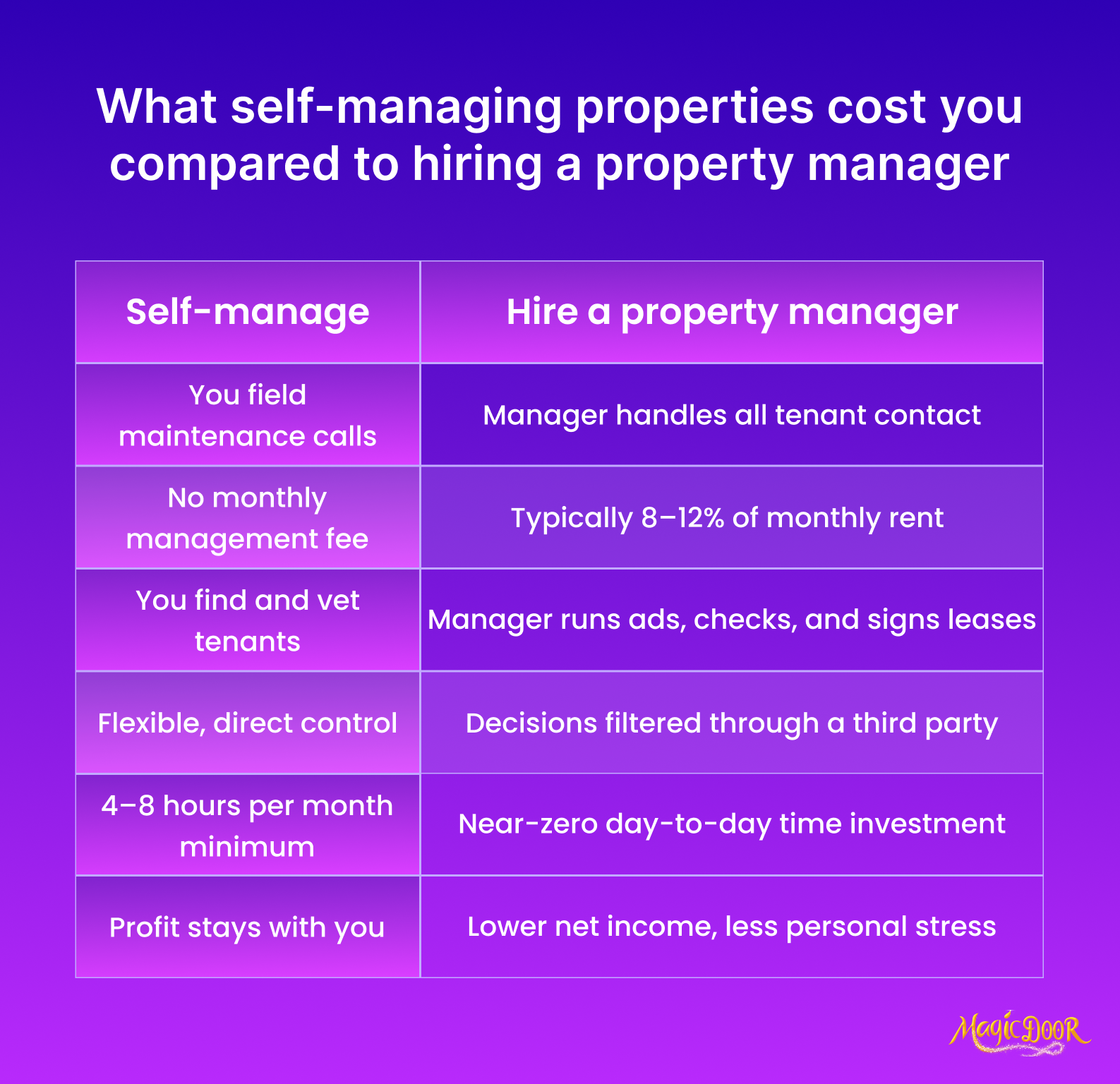
The decision comes down to two things: how much time you have, and how close you are to the property.
A property manager handles management responsibilities end-to-end, including tenant complaints, rent collection, repair coordination, lease renewals, and move-in logistics. For landlords who treat the rental as a passive investment, or who own property in another city, that service is worth the fee.
Property management fees typically run 8–12% of monthly rent, plus leasing fees when new tenants move in.
For landlords who want to stay involved or who manage one or two units and want to save money, DIY property management is a reasonable choice. People skills matter here. So does the willingness to respond promptly when a water heater fails, or a water leak gets reported at an inconvenient hour.
The question isn't which option sounds better. It's which one fits how you work.
Consider how you land on each of these:
- Time availability: Managing tenants, coordinating major repairs, and staying current on landlord-tenant laws takes consistent attention, not constant, but reliable
- Proximity: Self-managing a property you can reach in 20 minutes is different from managing one two states away
- Financial margin: Property management fees reduce cash flow; weigh that against the cost of your own time
- Control preference: Some landlords find delegation uncomfortable, particularly around tenant screening and how repair issues get handled
There's also a middle path. Property management software lets DIY landlords handle rent payments, track maintenance, store lease documents, and manage tenant communication without hiring a full-service manager. For owners who want control without the administrative weight, that's where most landlords eventually land.
The choice isn't permanent. Many landlords self-manage early, build their process, then outsource specific tasks as the portfolio grows.
What is The Right Way to Price Your Rental Property?
Rent price is where most landlord decisions start, and where a lot of money gets quietly left on the table, or lost through extended vacancies.
Pricing too high keeps the unit empty. Pricing too low attracts the wrong prospective tenants, or locks you into below-market rent for the length of the lease. Neither outcome serves the rental business.
Start with fair market rent for your specific area.
That means looking at comparable properties: similar size, condition, location, and amenities, currently listed or recently rented nearby. Rental listing platforms give you a reasonable baseline. A local property manager can give you a more thoughtful read on the market if it's competitive.
From there, adjust based on what your property offers:
- In-unit laundry, parking, or outdoor space typically supports a higher rent price
- Older appliances, shared amenities, or deferred maintenance pull the number down
- Neighborhood vacancy rates signal how much flexibility the market gives you
- Seasonal demand matters more in some markets, listing in peak rental season versus the middle of winter affects how quickly you fill the unit
One thing worth knowing early: tenant turnover is expensive. A vacant unit, a new rental listing, and another round of screening add up fast. A rent price that retains quality tenants, even slightly below maximum, usually produces better cash flow than pushing the number and refilling every 12 months.
Review pricing at every lease renewal. Fair market rent changes, and staying current protects your investment property from drifting behind the market over time.
How to Screen & Approve Tenants for Your Rental Property
Who you place in the property determines almost everything that follows. A reliable tenant makes management straightforward. The wrong one makes it expensive.
The tenant screening process has four components that matter:
- Credit check: Look for consistent payment history, not a perfect score. Patterns of missed payments or collections on utility accounts are more telling than the number itself.
- Background and eviction check: Prior evictions are the clearest signal of future risk. A background check adds context, but apply it within the boundaries of your local landlord-tenant laws, which vary by state.
- Income verification: The standard benchmark is gross monthly income at three times the monthly rent. Pay stubs, bank statements, or employer letters all work. Self-employed applicants need more documentation, not less scrutiny.
- Rental history: A call to the previous landlord takes five minutes. Ask whether they'd rent to the applicant again. The hesitation before the answer is usually informative.
Here's what ties it together: the criteria have to be the same for every applicant. Inconsistent standards create Fair Housing Act exposure. Document what you require before applications open, apply it uniformly, and keep records of every decision. That paper trail protects you if a rejection is ever challenged.
Property management software handles a meaningful part of this by running credit, background, and eviction checks through a single interface, storing applications, and keeping the whole process documented without a separate filing system.
Quality tenants don't just pay rent on time. They report maintenance issues early, treat the property with care, and renew leases, which is the cheapest outcome for any landlord.
What Every Solid Lease Agreement Needs to Cover
A lease does two things: sets expectations before they become disputes, and gives you documentation when they do anyway. A vague lease doesn't protect anyone; it just delays the argument.
The basics every rental agreement needs:
| Clause | What It Should Specify |
|---|---|
| Rent amount & due date | Monthly figure, due date, accepted payment methods |
| Late fees | Exact amount, grace period, and how fees are applied |
| Security deposit | Amount, what it covers, return timeline per state law |
| Maintenance responsibilities | What the landlord handles, what the tenant handles |
| Entry notice requirements | How much notice do you give before entering the property |
| Lease term | Start date, end date, renewal conditions |
| Pet and subletting policy | Permitted or not, ambiguity creates problems |
| Utilities | Who pays what, and how disputes get handled |
Beyond the structure, a few specifics matter more than landlords expect.
Rent payment terms deserve their own clause. Spell out whether tenants can pay rent online, which platforms are accepted, and what happens if a payment bounces. Rent reminders and automatic payments reduce late collections, but only if the lease establishes the framework first.
Safe and habitable condition language protects both parties. The tenant's right to a habitable property, functioning hot water and heat, and no active leaks must be explicitly stated, alongside the tenant's obligation to report issues promptly. A tenant who sits on a water leak for three weeks has less standing if the lease required timely reporting.
Have it reviewed before it's signed. A customized lease built for your specific property and state is worth the cost. Generic templates miss local landlord-tenant law requirements, and a non-compliant clause can void the entire provision it was meant to enforce.
Digital signing tools, such as electronic lease signing, eliminate the logistics problem; both parties can execute the agreement remotely, and the signed copy is stored without a filing cabinet.
How to Collect Rent & Handle Late Payments as a Landlord
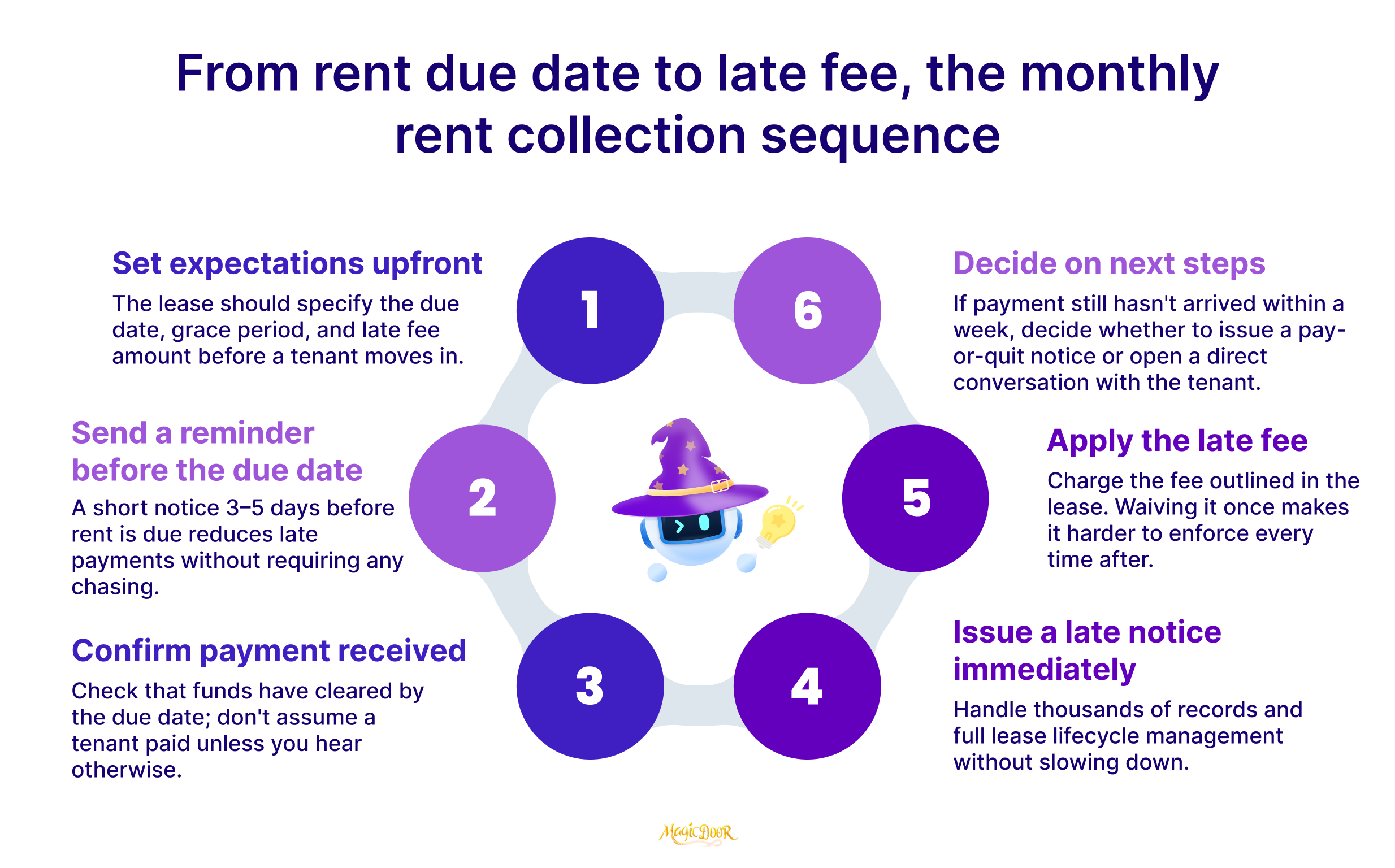
Rent collection sounds administrative. It becomes a management problem the moment there's no clear system behind it.
Cash and checks create differences, payments that arrive without timestamps, deposits that require manual tracking, and no automatic record of who paid what and when. Most tenants who pay late aren't deliberately difficult. They're disorganized. The same is true for landlords who chase payments manually every month.
Collecting rent online fixes most of this before it starts.
When tenants can pay rent online, through a portal tied to the property, payments are timestamped, receipts are automatic, and the landlord has a running record without a spreadsheet. Automated rent reminders go out before the due date.
Late fees apply as specified in the lease, without a conversation. For DIY landlords managing multiple units, that removes a significant slice of monthly admin.
A few practices worth building in from the start:
- Keep all rental income in a separate bank account from personal finances. It clarifies cash flow, simplifies tax records, and is standard practice for anyone running a rental as a business
- Apply late fees consistently. Waiving them occasionally is fine; doing it repeatedly signals that the due date is flexible
- Document every payment. Rent receipts create a paper trail that protects both parties if a dispute reaches a tribunal or court
On arrears: a tenant who goes quiet after missing a payment is a different situation from one who communicates early. Landlords who maintain regular contact with tenants, not just at problem moments, tend to hear about financial difficulties before they become two months overdue. That window matters for how you collect rent and whether you can resolve it without escalating.
Managing rent arrears effectively protects cash flow and, more practically, avoids the time and costs of an eviction process that could have been prevented earlier.
Rental Property Maintenance Responsibilities Every Landlord Should Know
Routine Maintenance vs Emergency Repairs
These two categories need separate systems, not the same response process.
Routine maintenance is scheduled, predictable, and preventable. Emergency repairs are none of those things, and handling them with the same casual timeline as a paint touch-up is what breaks down landlord-tenant relationships fast.
| Routine Maintenance | Emergency Repairs | |
|---|---|---|
| What it includes | Seasonal servicing, filter changes, gutter cleaning, appliance checks | No hot water, active water leaks, heating failure, or electrical faults |
| Timeline | Scheduled in advance | Same day, often within hours |
| Planning tool | Maintenance checklist reviewed each season | Emergency fund + vetted contractor list |
| Tenant impact | Minimal disruption when communicated early | High, directly affects habitability |
An emergency fund specifically for the rental property isn't optional. Repairs don't wait for cash flow to align, and a landlord without a financial buffer for urgent fixes creates a habitability problem, which carries legal exposure.
How Often Should Landlords Inspect Their Rental Property?
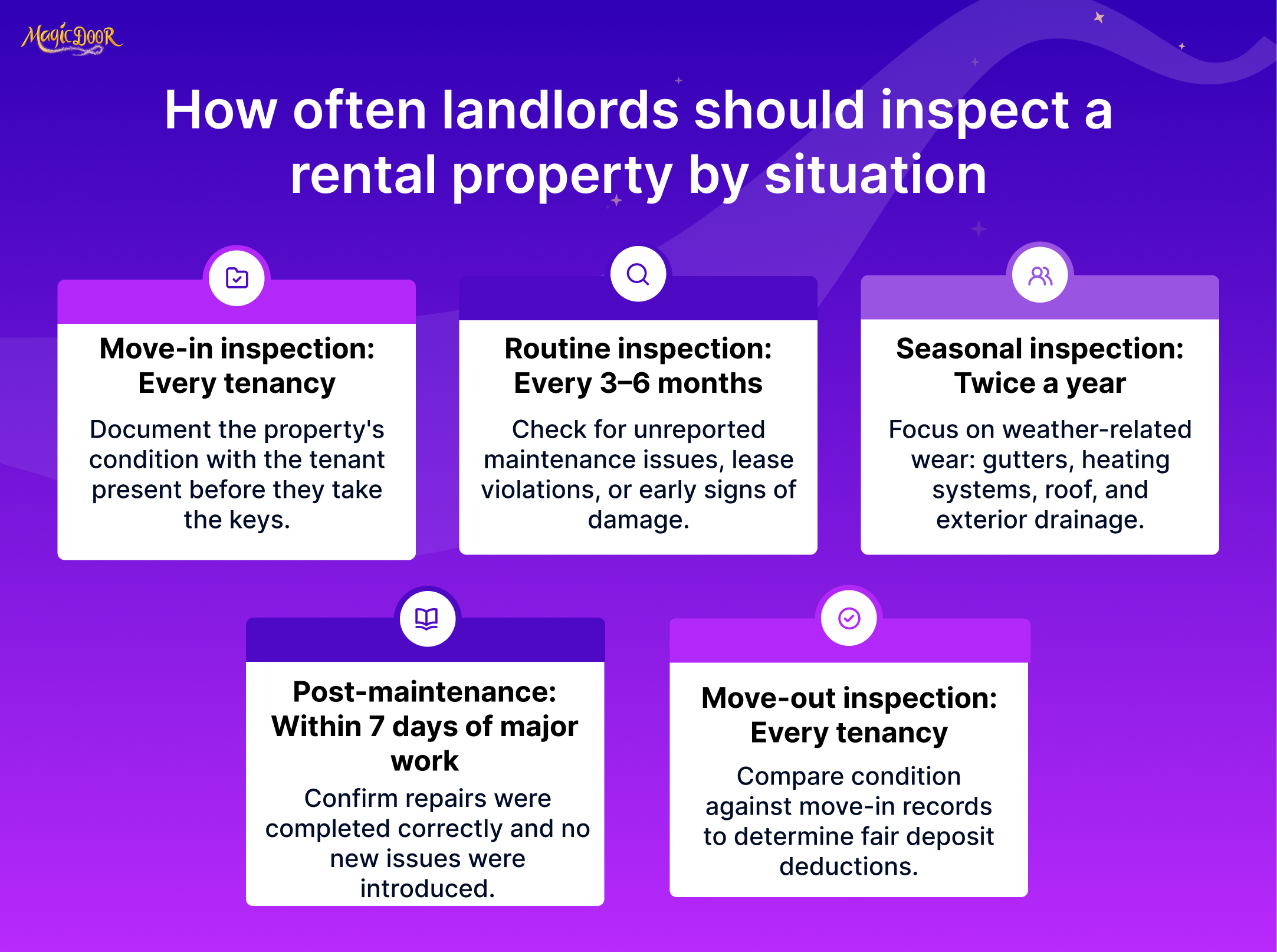
Regular inspections are the most direct way to stay current on the property's condition without relying on tenants to report every issue.
A practical inspection schedule for most rentals:
- Move-in: Document everything, room by room, with photos. This is the baseline that determines what's wear and tear versus damage at move-out
- Mid-lease (every 6 months): Check for unreported maintenance issues, safety compliance, and lease adherence
- Seasonal: HVAC filters, smoke detectors, exterior drainage, weatherproofing, caught early, these stay cheap
- Move-out: Document against the move-in record before returning the security deposit
Give proper notice before every entry, the required period varies by state, but 24–48 hours is standard in most jurisdictions. Unannounced inspections create legal risk regardless of what the lease says.
What Repairs Are Landlords Legally Responsible For?
The legal standard is straightforward: landlords must maintain the property in a safe and habitable condition. What counts as habitable is defined by state and local law, but the core obligations are consistent across most jurisdictions.
Landlords are responsible for:
- Functional heating, plumbing, and electrical systems
- Weatherproofing, windows, doors, roofing
- Hot water supply
- Smoke and carbon monoxide detectors
- Structural integrity of floors, walls, and ceilings
- Pest control in most cases, unless tenant behavior caused the infestation
Understanding what repairs fall to the landlord versus the tenant prevents disputes and protects against habitability claims. Document every repair, date reported, date completed, and contractor used. That record matters if the tenancy ends in a dispute.
Landlord insurance covers major structural damage and liability. Renters insurance covers the tenant's belongings. Both should be in place before a tenant moves in, and the lease should require renters' insurance.
How to Handle Maintenance Requests From Tenants
Tenants who feel comfortable reporting issues early save landlords money. A slow water leak reported in week one costs less than the same leak discovered in month three.
The process matters as much as the response time.
- Give tenants a clear way to submit requests. Text threads are unreliable. A dedicated channel, whether a property management platform or a work order system, creates a record from the moment the request is submitted.
- Acknowledge every request promptly. Confirmation that the request was received isn't the same as fixing it immediately, but it prevents the tenant from assuming nothing is happening. Silence reads as neglect.
- Set a realistic timeline and keep to it. Non-urgent repairs can wait a few days. Anything affecting habitability cannot. Communicate the timeline, then update the tenant if it changes.
- Document completion. Log what was done, when, and by whom. That record protects the security deposit conversation at move-out and demonstrates the property was maintained if a dispute arises.
Landlords managing multiple rentals benefit from maintenance tracking tools that consolidate requests, contractor assignments, and completion records in one place, rather than across text threads, emails, and memory.
How to Manage Tenant Communication & Resolve Issues Effectively
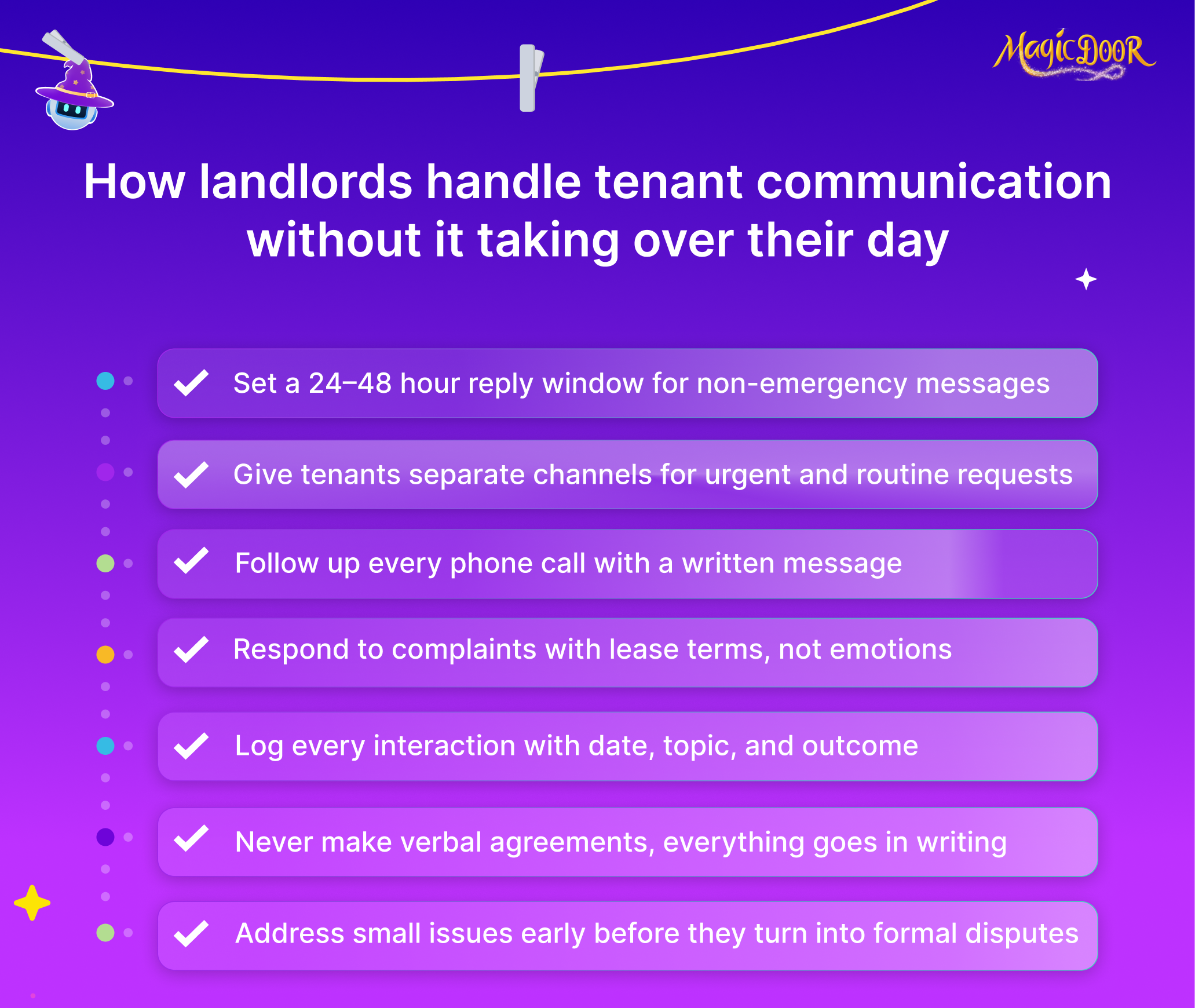
Good tenant communication isn't about being available at all hours. It's about being consistent and clear enough that problems get reported early, not ignored until they're expensive.
Tenants who feel ignored don't stay. They also don't report maintenance issues promptly, don't pay rent reliably, and don't give notice far enough in advance when they decide to leave. The relationship between a landlord and tenant is professional, but it still functions on trust.
A few communication habits that hold up across the length of a tenancy:
- Set expectations at move-in. A move-in checklist and a brief walkthrough of how to submit requests, report issues, and reach out to you puts everyone on the same page before anything goes wrong
- Use a consistent channel. Text threads split across personal phones create gaps. A single platform for all tenant communication keeps records intact and responses traceable
- Acknowledge before you resolve. A tenant who submits a repair request and hears nothing assumes nothing is happening. A quick confirmation, even just that you've received it and are following up, prevents most of the frustration that turns minor issues into formal complaints
Handling complaints is a different skill. Most tenant complaints are legitimate and worth addressing directly. Some are unreasonable. The line between them is usually clear, the difficulty is in staying professional when a complaint feels disproportionate. Document every exchange regardless of how it ends. That record matters if a dispute escalates.
Tenant communication tools that centralize messages, maintenance requests, and lease documents in one place reduce the administrative drag of managing tenants across multiple threads and inboxes. For DIY landlords managing their rental alongside other commitments, that consolidation is where much of the time is recovered.
Effective tenant management isn't built around reacting to problems, it's built around a communication structure that prevents most of them from compounding in the first place.
Rental Property Accounting & Financial Record-Keeping for Landlords
Running a rental property without tracking the finances is how landlords end up surprised at tax season, or unable to explain where the cash flow went.
The accounting side of managing rental properties isn't complicated, but it requires consistency from the start. Every dollar in and every dollar out needs a record. Rental income, repair costs, landlord insurance premiums, professional fees, maintenance invoices, all of it. Not because an audit is coming, but because the numbers tell you whether the property is actually performing.
Property management accounting for a rental breaks into three practical habits:
- Separate the money: Rental income should never sit in a personal account. A dedicated account for the property makes income and expenses immediately visible, simplifies record-keeping, and is standard practice for anyone managing rentals as a business rather than a side arrangement.
- Record everything in real time: Receipts that get filed monthly are better than receipts that get reconstructed in April. Rental property owners who log expenses as they occur, repairs, contractor invoices, supplies, don't face the same end-of-year scramble as those who don't.
- Keep lease and payment records indefinitely: Rent receipts, signed lease agreements, move-in documentation, and security deposit records all have potential legal relevance long after a tenancy ends. Store them somewhere that isn't a physical folder.
Tax preparation is where poor record-keeping costs real money. Landlords can typically deduct mortgage interest, repairs, property management fees, landlord insurance, and depreciation, but only what's documented. Preparing for tax season is significantly less painful when the records have been maintained throughout the year rather than assembled from memory.
Review the numbers annually, not just at tax time. Rental income that hasn't kept pace with rising maintenance costs or market rents is a quiet problem, one that compounds before most landlords notice it.
Common Rental Property Management Mistakes New Landlords Make
Not Screening Tenants Thoroughly Before Signing a Lease
Skipping or shortcutting tenant screening is the most expensive mistake a new landlord makes, and the most avoidable.
A thorough screening process covers credit history, background checks, prior evictions, and income verification. Each one removes a different category of risk. Landlords who skip even one step because an applicant seems reliable in person are making a judgment call with significant financial consequences attached.
Two things make the difference between a functional screening process and a liability:
First, advertise across multiple platforms to generate enough rental leads that you're choosing between applicants rather than approving the first one who applies. A thin applicant pool forces rushed decisions.
Second, apply the same criteria to every applicant without exception. Inconsistent standards create Fair Housing Act exposure, and "I just had a good feeling about them" is not a defensible screening record. Property management software that runs credit, background, and eviction checks through a single interface keeps the process documented, consistent, and legally defensible.
Finding reliable tenants upfront reduces every management headache that follows for the length of the tenancy.
Setting the Wrong Rental Price From the Start
Price too high and the unit sits vacant while carrying costs accumulate. Price too low and you're subsidizing the tenancy while limiting cash flow, and in most markets, clawing back a below-market rent price means waiting for a turnover that costs money to execute.
A few things new landlords miss on pricing:
- Never increasing rent over a multi-year tenancy is the practical equivalent of a rent reduction, inflation erodes the real value of flat income year over year
- High-quality photography in the rental listing meaningfully reduces vacancy time, presentation affects how quickly qualified applicants respond
- Annual market reviews keep rent aligned with comparable properties, not to squeeze tenants, but to ensure the investment property performs the way it should
Setting the right price requires checking what similar rentals in the area are actually achieving, not just what they're listed at.
Failing to Put Lease Agreement Terms in Writing
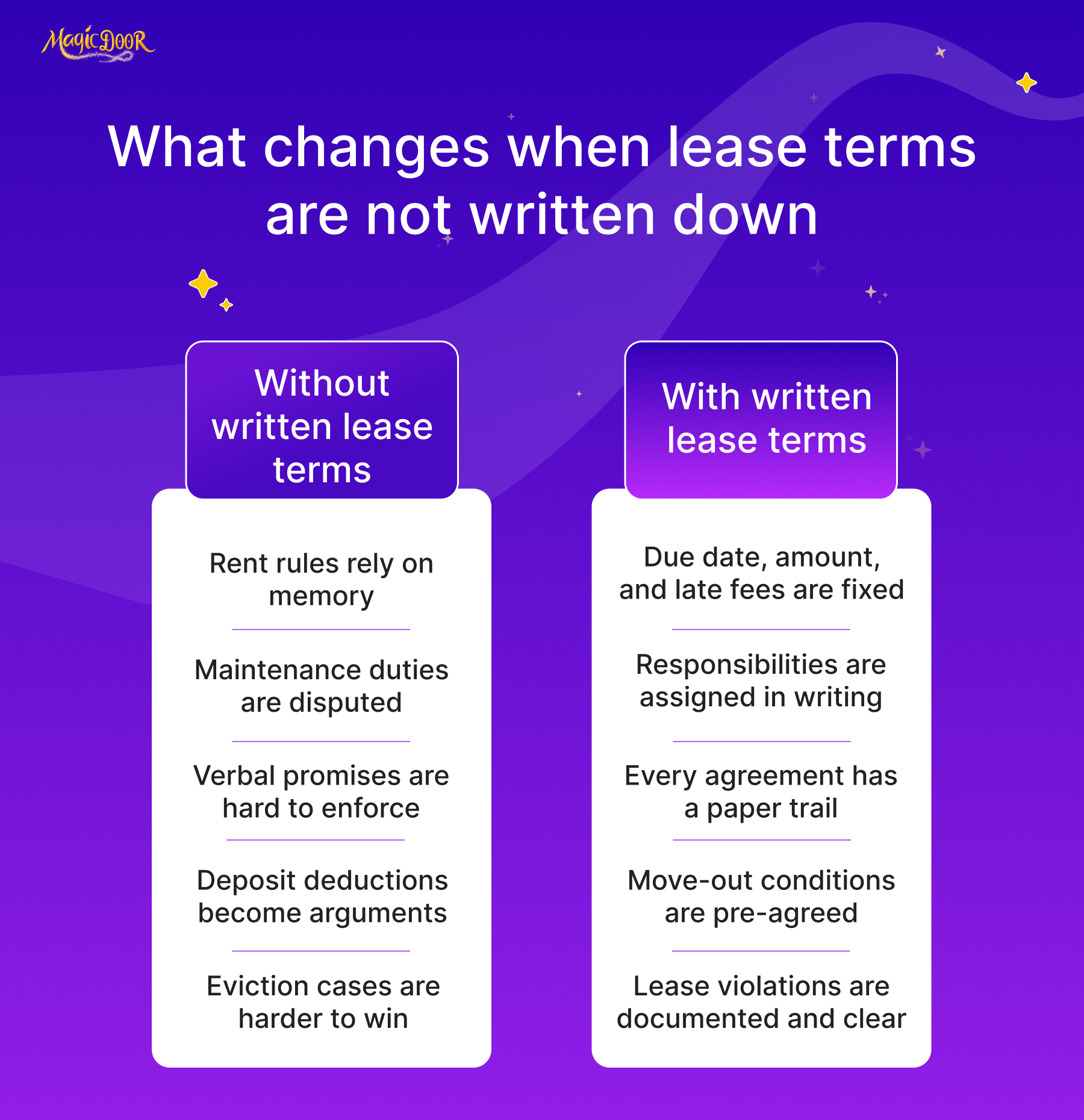
A verbal agreement between a landlord and tenant isn't a lease. It's a disagreement waiting for a trigger.
Every material term needs to be written, signed, and stored, rent amount, due date, late fees, security deposit conditions, maintenance responsibilities, notice requirements. Landlords who leave any of these implicit find out why that was a mistake the first time a tenant disputes a charge.
The lease also needs to comply with local ordinances. A clause that conflicts with state landlord-tenant law is unenforceable, regardless of whether both parties signed it. Having the agreement reviewed by a lawyer before it's used, not after a problem surfaces, is the kind of upfront cost that prevents much larger ones.
Neglecting Regular Property Inspections
Most property problems that become expensive started small. A slow leak. A failing seal. An HVAC filter that hasn't been changed in 18 months. Regular inspections catch these before a minor repair becomes a major one.
Inspections also serve a legal function. Documenting the property's condition at move-in, mid-tenancy, and move-out creates a clear record that separates normal wear from actual damage, which directly affects how the security deposit gets handled. Landlords who skip the move-in documentation often find themselves unable to justify deductions they're legitimately owed.
Safety checks, smoke detectors, carbon monoxide alarms, and electrical panels must be completed on schedule, regardless of whether a tenant has reported anything. Legal compliance here isn't discretionary, and "no one mentioned it" isn't a defense.
The rental property maintenance checklist is the most practical tool for ensuring nothing gets missed between tenancies or during seasonal inspections.
Trying to Manage Everything Without a Property Management System
Managing rental properties across text messages, email threads, a personal bank account, and a spreadsheet works until it doesn't. The volume doesn't need to be high for the gaps to appear. One missed repair request, one undocumented payment, and one lease that can't be located quickly are enough to create a real problem.
A property management system addresses this specifically:
- Rent collection moves online: payments are timestamped, receipts are automatic, and rent reminders go out without manual follow-up. Tenants who pay online tend to pay more consistently than those relying on manual methods
- Maintenance requests are tracked: from submission through completion, with a documented record attached to each property
- Lease documents and tenant records: are stored in one place, accessible when needed
- Late fees apply automatically: based on lease terms, no conversation required, no inconsistency in enforcement
- Financial records stay current: without reconstruction at year-end
Managing a rental property like a business doesn't require more hours. It requires the right structure so that rent gets collected, repairs get tracked, and records stay up-to-date, without having to rebuild everything from scratch each time something slips.
Manage Your Rental Property With Confidence Using MagicDoor
Everything covered in this guide, screening tenants, pricing the unit, writing a solid lease, collecting rent consistently, coordinating maintenance, staying on top of finances, is manageable. The difficulty isn't any single task. It's running all of them in parallel, without a system that connects them.
That's the problem MagicDoor is built to solve.
Rent collection, tenant communication, maintenance tracking, lease management, and financial reporting all run from one platform, at $2.50 per active lease per month, with no features locked behind higher tiers.
For landlords who want to stay in control of their rental without the administrative weight that usually comes with it, that's worth seeing firsthand.
Try MagicDoor for free (up to 10 units)
Conclusion
Every section of this guide comes back to the same pressure point.
A rent price set without market data costs money at every renewal. A lease with vague terms creates disputes that documentation would have prevented. A maintenance request that goes unacknowledged becomes a habitability complaint. Finances tracked informally become a tax season problem.
None of these are random, they follow directly from skipping the process. Landlords who screen thoroughly, document everything, collect rent through a channel that creates automatic records, and review their numbers annually are running the same property as everyone else. The difference shows up in what doesn't go wrong.
Property management software has made that level of consistency accessible for landlords at any portfolio size, automating rent reminders, maintenance tracking, lease renewals, and financial reporting without adding administrative work to get there.
Related articles






One platform for smart AI-automated rental management